


 SHARE:
Recently, the PBS program Nova featured a robotic version of Philip K. Dick. The famed sci-fi writer's human form has been gone for 29 years but the android filled in rather well -- smiling, joking, philosophizing, all while moving his head back and forth in convincing fashion. Now if they can just get the android to pop out some screenplays, a whole lot of Hollywood hacks will be out of work.
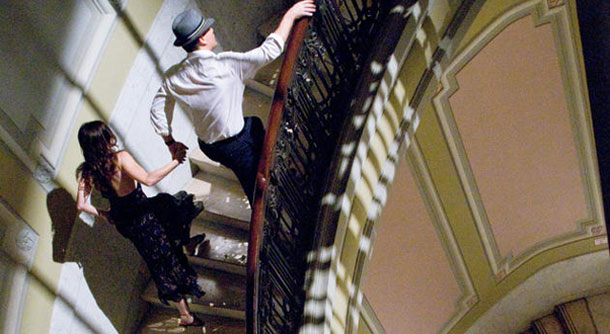
Dick's work has been a favourite cinematic source ever since his novel Do Androids Dream of Electric Sheep? became Blade Runner. Dick died in 1982 just before Blade Runner premiered, but his stories and novels have since been transformed into films like Minority Report, Total Recall, Screamers, and A Scanner Darkly. Now comes The Adjustment Bureau, starring Matt Damon, Emily Blunt and Mad Men's John Slattery. It offers the kind of "Whoa, dude" concept every stoner loves, but without the Inception-level of complexity that overloads that poor stoner's compromised neural network. As for the un-stoned, they may leave The Adjustment Bureau underwhelmed.
Damon plays David Norris, a feisty young pol headed for a Senate seat until a college-era moon shot causes the sun to set on his campaign. As he prepares his concession speech he meets a woman. In a men's room. It's what screenwriters call a meet-cute and it is, for once -- Blunt's character Elise does seem a spunky sort. Shortly afterward he bumps into Elise on a New York bus. Romance and a revived political future are in the air.
Back to Plan A
But no. This is not the Plan. Norris will soon meet a couple of grey men, led by Slattery, who work for a quasi-supernatural bureaucracy called the Adjustment Bureau. Slattery proceeds to explain that there's been a mistake and this is not the way things were supposed to work. It turns out there is a plan for each of us, just like the priests and preachers have always said. Except it's a lot blander than the Renaissance frescoes. For instance, the author of these great plans is referred to as the Chairman. Some will not be surprised to learn that Frank Sinatra is running things, but surely they could find a better and less sexist name -- Chair-deity, Chair-Yahweh, or Chair-Eric Clapton?
The chairman of The Adjustment Bureau is director/screenwriter George Nolfi, who wrote the script for Damon's hit The Bourne Ultimatum (sample scene: "Bourne runs.") The idea of a screenwriter acting as director always holds promise -- this guy, you assume, won't take the Michael Bay "Write me some more explosions" approach. Early on The Adjustment Bureau has some crackle and a few good lines. But notwithstanding the requisite suspension of disbelief, fantasy epics live or die on the power of the universes they create, and this one feels like it was plucked from a sci-fi remainder bin. As new-model angels, the grey men of the Adjustment Bureau are surprisingly inept. And the necessary plot shenanigans that will allow our heroes to subvert authority -- bits of business involving, I kid you not, water and hats -- lead to the film's most unintentionally risible warning: “Sir! He's got a hat!”
Headed where?
Inception may have been confusing, perhaps even muddled, but it did present viewers with an impressive puzzle. The Adjustment Bureau will not tax even the most chemically addled brain in the audience. And fittingly for such a water-based plot, the ending turns out to be a damp squib.
More interesting is the history of the Philip K. Dick android. The robot's original head has gone missing. While en route to a 2006 exhibition the android's head was left on a plane in a carry-on bag. It was subsequently placed on a flight to San Francisco, whereupon it disappeared. A new head was built. But the original may still be out there, roaming the Frisco backstreets in a bell jar. That's a flick I'd pay to see. ![[Tyee]](/design-article.thetyee.ca/ui/img/yellowblob.png)
Read more: Film









Tyee Commenting Guidelines
Comments that violate guidelines risk being deleted, and violations may result in a temporary or permanent user ban. Maintain the spirit of good conversation to stay in the discussion.
*Please note The Tyee is not a forum for spreading misinformation about COVID-19, denying its existence or minimizing its risk to public health.
Do:
Do not: