- John Westover is a Tyee Builder. You can be, too.
- Nora Etches is a Tyee Builder. You can be, too.
- Edward Henderson is a Tyee Builder. You can be, too.
- Bharadwaj Chandramouli is a Tyee Builder. You can be, too.
- Dean Chatterson is a Tyee Builder. You can be, too.
- Marius Scurtescu is a Tyee Builder. You can be, too.
- Robert Parkes is a Tyee Builder. You can be, too.
- James Murton is a Tyee Builder. You can be, too.
- Susan Doyle is a Tyee Builder. You can be, too.
- Vincent Strgar is a Tyee Builder. You can be, too.
- Helen Spiegelman is a Tyee Builder. You can be, too.
- Subir Guin is a Tyee Builder. You can be, too.
- Kimball Finigan is a Tyee Builder. You can be, too.
- Joanne Manley is a Tyee Builder. You can be, too.
- David Leach is a Tyee Builder. You can be, too.
- Joel Berger is a Tyee Builder. You can be, too.
- Heather Sapergia is a Tyee Builder. You can be, too.
- Dittmar Mundel is a Tyee Builder. You can be, too.
- Hardev Bal is a Tyee Builder. You can be, too.
- David Sims is a Tyee Builder. You can be, too.
Pilgrimage with David Suzuki
Sturla Gunnarson, director of the bio-doc 'Force of Nature,' on Suzuki's anger, urgency and faith in miracles.
'Sense of hope': David Suzuki in 'Force of Nature.'
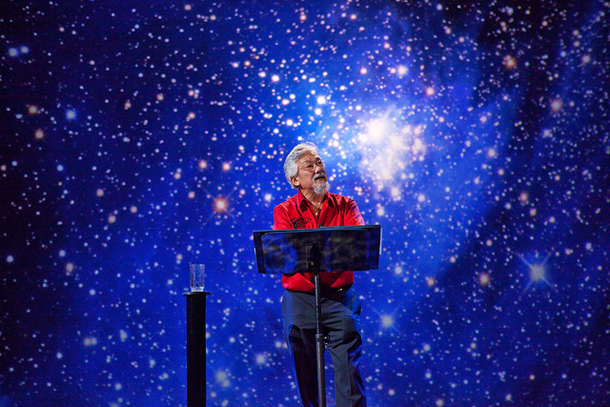
Last December, at the age of 73, David Suzuki gave a lecture at the Chan Centre in Vancouver based on the premise -- 'If I had one last lecture to give, what would I say?'
Icelandic born, B.C.-raised filmmaker Sturla Gunnarson, who has earned acclaim through fact and fiction (Beowulf and Grendel; Gerry and Louise; Rare Birds, Such a Long Journey) used that lecture as the launching point for his new movie Force of Nature -- an intimate biography blended with a passionate call to action that just played VIFF 2010 and opens Oct. 15 at Vancouver's Fifth Avenue Cinemas.
The film premiered at the 2010 Toronto International Film Festival, where Suzuki proved he was a bigger deal than every other star in attendance, hosting a $1,500 a seat party to raise money for an environmental group with a name that must be easy for him to remember -- The David Suzuki Foundation.
The geneticist turned TV host has been Canada's face of environmentalism for so long he's as iconic as the beaver and the polar bear. He's been sounding the alarm bells about global warming since the days when people only wore sunscreen to enhance their tans. His TV series The Nature of Things started on CBC in the '70s and is seen in 40 countries.
So by various measures, David Suzuki is one pretty great Canadian. In fact, in 2004 CBC TV ran a series called The Greatest Canadian in which viewers voted for, well, the greatest Canadian. The winner was Medicare founder Tommy Douglas. The only living contender in the top five was Dr. David Suzuki. The other three Canadians who beat him were Terry Fox, Pierre Trudeau and the codiscoverer of insulin. Dr. Frederick Banting.
While I was covering TIFF for The Tyee, I made contact with Force of Nature director Gunnarson who was fighting a bug, but agreed to answer 10 questions online.
What's your history with David Suzuki?
"When I was an undergrad at UBC, Suzuki was a professor who had kind of a rock star star status on campus. He was charismatic, loved by his grad students and very much at the forefront of the cultural revolution that was sweeping campus. Though I was studying the English romantics and getting high on Blake, and Suzuki was a genetics prof, the way he talked about science was every bit as trippy as the poets I was reading.
"At the time, a lot of his ideas about the environment and the interconnectedness of life were considered pretty radical and resonated strongly with me.
"Thirty years later, his ideas have been broadly embraced and form a kind of orthodoxy of the environmental movement. When I had the opportunity to finally meet him, I jumped at the chance. I wasn't sure if there was a movie to be made or if I had anything to add to the Suzuki legend, but was happy to meet him after 30 years of knowing him from afar. We connected almost immediately, in part, I think, because we're both B.C. boys and both had our first experience of wonder and awe on the B.C. landscape. And we're both hard-core fishermen.
"We talked initially about metaphysical ideas -- the birth of the universe to the present moment of environmental crisis, evolution, consciousness, etc. But as our discussions unfolded, I became more fascinated with the man himself and this particular moment in his life -- his sense of urgency about getting his message out combined with his real intimations of mortality and taking stock of his life. The film basically grew out of that"
It has been a long time since your last documentary. What drew you back to the doc world to tell David Suzuki's story?
"It hasn't really been that long. I made Air India 182 in 2008. Before that was Gerrie & Louise in 1997. Though I've done a lot of dramatic work, I never really felt as though I left the documentary world. My films are all narrative, and aesthetically, I've always tried to make the documentaries feel dramatic and the dramatic films feel real. Since 9-11 and the bizarre unraveling of values and consciousness I took for granted as the cornerstone of our social contract in the western world, I've been finding it more difficult to engage with fiction as it mostly seems to pale in comparison with the reality we're living, which has played some part in making the docu world seem more compelling to me.
The film has some powerful moment when you're on the road, like visiting the internment camp where he was raised and the last place he hiked with his father. What was it like travelling with Suzuki to the places that created and defined him?
"Travelling with David was a great experience. The theory was that if we returned to places of deep personal meaning to him it would elicit a process of discovery and recovery and allow him to tell his story in a way that transcended the expositional dimension and have more of a dramatic/emotional characteristic.
"As it turned out, I think a lot of what's in the film involves David discovering connections and recovering memories from his own narrative that he wasn't fully aware of. It was kind of like the sense memory work we do with actors when constructing a character, but in this case it was more about discovering something that had been there all along.
"When we hiked up to Beatrice Lake, for example, it was a very challenging experience -- three days of hiking up a mountain with hundreds of pounds of film gear, tents, food provisions, etc. At the outset, one of our coordinators offered up a lake that was just as beautiful as Beatrice which we could have virtually driven to.
"What difference does it make, they asked, one tree looks pretty much like another -- which is true. But somehow, it was the making of the real journey and the real pilgrimage to the place he had fished with his father as a child that earned us the deeply personal interviews that characterize the film."
What surprised you about his story? I spoke to a few viewers who were surprised by his anger towards white people during his early years.
"What surprised me the most was the sense of vulnerability that David revealed to me over our journeys. It surprised me that somebody with such an incredible body of achievement, who's looked up to by so many people still feels the need to prove himself in Canadians' eyes. The deep impact that being interned, and seeing his parents shamed and disenfranchised had on him. It made me reflect on how powerful our childhood experiences are in shaping our characters."
Why the decision to focus more on Suzuki's biography than his philosophy?
"I tried to focus on both. There's an old saying, though -- if you want to make a film about ideas, find a character who cares passionately about the ideas. For me, film is an dramatic/emotional medium. I'm not drawn to cerebral films -- I like character and narrative, which is probably why I approached it this way."
Did you ever consider making something more like David Suzuki's Last Waltz -- which was pretty much how the speech you shot was billed?
"Well, I do think of it as a kind of Last Waltz. That film was pretty much my inspiration for this one. It's not a direct analogue -- the personal narrative in Last Waltz is definitely subordinate to the performance aspect, whereas the personal narrative emerged as the driving force in FON. Every film takes on a life of its own and you have to embrace that and allow it to reveal itself. Still, it's a similar structure with similar intentions."
When this comes out on DVD will we see the whole speech?
"Yes, the entire lecture will be a bonus feature on the DVD."
Which environmental issues are you passionate about?
"Well, as a fisherman, I'm deeply distressed by the destruction of our oceans and watersheds. I grew up catching and eating fish from the wilds and I brought my children up the same way. I'm deeply concerned that that experience will not be available to my grandchildren -- that they'll never know the experience of being in a pristine ocean or watershed, of directly experiencing the cycle of life and intuiting the mystery and awe of a natural world and knowing, if only fleetingly, how insignificant we are in the scheme of things."
What are you hoping viewers will take away from the film? Any responses you're please with/surprised by so far?
"I'm hoping people will come away from the film feeling a sense of hope and possibility in the face of the enormous challenges we face. The relentless grind of bad news can be so discouraging and lead us to feeling impotent in the face of powerful forces that we feel we have no power to influence. I think Suzuki's core message is that, in spite of everything, the natural world has miraculous regenerative powers and that small actions can make a big difference.
"We cannot change BP and the thousands of other villains out there, but we can change ourselves -- we can become aware of our footprint in the world and we can question how much of all that stuff we really need. We have the opportunity to rediscover things that are more meaningful and satisfying than the consumer orgy we're indulging in and to reconnect with the numinous in nature."
When CBC produced their TV series The Greatest Canadian in 2004, David Suzuki ranked number five -- the only four people above him were all dead. Do you feel David Suzuki is the greatest living Canadian?
"I'm not big on lists or singing and skating contests. I believe David Suzuki is an environmental visionary who's led a remarkable life and maintained a consistent moral rudder. He appeals to the better angels of our nature and reconnects us with values we once held dear." ![]()


24
Login or register to post comments
Frank
1 year ago
Suzuki
The interment of Japanese-Canadians was a shameful moment in our history. The only solace is the past is a different country, people had views back then that are no longer shared by the majority.
Attacking the NDP during an election campaign because they didn't support Campbell's carbon tax, which has failed to do anything except raise taxes on the poor, was a shameful moment in Mr Suzuki's.
Let's hope the next generation of environmental leaders have better ideas than taxing the poor until they cry uncle and stop using resources better left to the wealthy.
freebear
1 year ago
I had a deep respect for David Suzuki
until his advocacy for a carbon tax and thus support for the BC Liberal government!
He was coopted (willingly?) by the 'more of the same' with ineffectual 'tweaks' (to mollify the masses) Visionaries!
ostermann
1 year ago
Here is what a 70-year-old
Here is what a 70-year-old Kelowna writer had to say, about my research and Suzuki’s refusal to meet with me since 1989. “If the Suzuki Foundation represents the pinnacle of the environmental movement today, then this world is headed for not only financial and economic collapse but ultimately, human extinction.” Proof available at request.
KWD
1 year ago
myopic icons
"We cannot change BP and the thousands of other villains out there, but we can change ourselves -- we can become aware of our footprint in the world and we can question how much of all that stuff we really need.”
This is typical of the thinking that believes that once we recognize the consequences of our behaviours … political, economic and religious … we will suddenly find a path that leads to a life more satisfying, meaningful and in sync with nature. It’s an ideology that has become the mantra for the environmental movement.
In reality, it has become an obstacle to enlightenment; an obstacle to asking questions that will expose the forces that streer behavioural development in ourselves, and ultimately, the behaviour of the villains among us.
Focusing on consequences will never amount to more than bandaid solutions. The long term result of this myopia is legislation that tries to prevent villainous behaviour through the use of punishment. (Any parent that has tried to deal with deviant behaviour will understand how wrong-headed, and potentially destructive, this strategy can be.)
Until Suzuki and the environmental movement recognizes the failure of focusing on the consequences of behaviour and looks at its causes, the sense of urgency will continue to escalate.
freebear
1 year ago
Well said KWD
But the ENGO industry can 'sell' consequences of behaviour and raise money and continue to employ themselves while Earth and its inhabitants degrade!
Stewart MacKenzie
1 year ago
same old paradigm
Suzuki and other big environmental "leaders" have lost sight of the problem - leadership by iconic, bigger than life figures does not create a functional society.
The movement including Suzuki have helped enlighten the world about the crises we face. But they have operated under the existing mainstream social model in which there are commoners and nobles, managers and the managed, little people and big people. That has led to the takeover of the Green parties federally and provincially by well funded elitists who have shown no more democratic instincts in their own organizations than the brass of corporations - who they emulate in their attitudes.
I complained to leaders of groups like Sierra Club and WCWC in the 80s that our side of the debate was damaged by the use of misleading advertising and other propaganda. The answer was always: "That's what they (the industrial corporations) do.
When asked about her parachute jump into the Gulf Islands, Elizabeth May has answered that that is what the old line parties do.
Both Green parties have changed focus from building grassroots support and organization to getting the leader elected.
Perhaps May is too honest and selfless to be more worried about advancing her career than the goals of the party. The next leader may not be so altruistic and Voila! - a Green Harperist party.
If we keep using the same model we will keep making the same mistakes Allowing a small number of people to run organizations, political parties or even corporations mainly for their own glory or greed or other lower motivations than honest service, leads to economic and social disaster - as we can see!
This social model originated with the transformation of free and democratic cultures to "master/slave" cultures under the churches. Divine right of kings as an official ruling philosophy was put to an end when the Brits hacked the head off poor idiot Willie the 1st, but deeply instilled social obedience to the class system has never been overcome. Most people still behave as sheep if someone acts like a shepherd. It is harder to awaken the sheep from their sleepwalking to think for themselves than to find some sheep to shepherd and build your power base (flock). It works for swamis, TV evangelists, politicians and many others but it will not build or rebuild the social structures we need to see change!
If Suzuki and other BC green activists had stuck with the NDP and participated in the party, especially as industrial labour's power and influence has declined, the NDP could not only claim, but actually be the best alternative for working people and the environment. Instead, there was a self glorifying disconnection from the realpolitik which was that as Suzuki said twenty and more years ago, we have very little time to make changes before the changes will be imposed on us by more powerful forces than governments or armies. Just ask the folks in Bella Coola or Newfoundland or Prince Rupert!
freebear
1 year ago
Also agree with Stewart
I too faced the same thing with WCWC in Alberta.
ENGOs raely have an organic organization where succession takes place and mature management gives way to younger management!
KWD
1 year ago
best alternative?
“… the NDP could not only claim, but actually be the best alternative for working people …” and the environment.
The connection between support from the Suzukis and Greens, and the creation of better alternatives for workers is easy to see … with the NDP in power it’s possible that working people might see more from their labour … but it’s a bit harder to understand how greater NDP support would be a better alternative for the environment.
Are you claiming that the NDP will place the environment ahead of jobs and profits for workers? Will the NDP stop the flow of tarsands oil; or the steady increase in oil tanker traffic; or urban sprawl; or resource and infrastructure sell-offs; or deforestation and overfishing? Does it have a magic wand that will create a new land ethic? Does it have a plan for rebuilding social structures that will prevent religious fanatacism, dysfunctional political heirarchies and fraudulent economic policy?
The carnage may slow down … as the money moves elsewhere … but it’s doubtful the NDP will cause a truly significant shift in the rate of environmental degradation.
Stewart MacKenzie
1 year ago
The world is run by those who show up
I am claiming that the environmental activists could have had a great influence inside the NDP. I had a teensy bit of influence myself back in the day without having any big organization nor organized constituency nor even the time to contribute without taking away from my family. I watched the likes of Georgetti and Sihota and Miller and Glen Clark bully the wimpy, whining greens (and many social activists) out of the party, then watched the party shrink and become even more doctrinaire than before.
The great thing about the party system is that any citizen can join a party and by participating in policy making and party organizing can in fact influence who runs for office as well as how the party thinks. If your point of view isn't shared by others then no party will suit you nor be willing to act on your advice. However, if you do find a party where others share your ideas and place importance on your issues then you will have allies within the party and together you will be able to have an influence. If your numbers are large enough that influence will be huge as each party member has one vote when all the important issues are decided. If enough people join a party they will outnumber the forces of the powers that be, and this can happen one constituency at a time. Generally, those who run the party organizations can turn out enough warm bodies willing to vote the party line, simply because most citizens never get involved. Those in control are often there for themselves and their cronies and don't have unlimited numbers to call on - most of their minions are showing up already and could easily be overwhelmed if even a small percentage of voters started to take control of the parties from the inside.
So, I am suggesting that Suzuki and all the other green activists could have been a growing force in the NDP while labour's influence waned and that the bureaucrats, political wimps and paid political professionals would not own the NDP as they now seem to do.
KWD
1 year ago
a growing force
I can't help but wonder, when they show up, will this be how things unfold?
http://english.aljazeera.net/news/europe/2010/10/201010139395288665.html
Keeping in mind that workers in Greece are no different in their desire to protect labour's influence than workers elsewhere.
circle A
1 year ago
No matter what...
david suzuki does with the rest of his life,spent with the best enviornmental itentions,he`ll be despised by many for getting sucked in by campbells greenwash scam.
happy
1 year ago
Yeah, but circle A
Vander Zalm was despised too. Now he's worshipped.
Frank
1 year ago
happy
I recall reading that just under half the people signing the HST petition were Dipper supporters. Which by extension means there's a hell of a lot of Campbell supporters "worshipping" Vander Zalm.
I can see why NDP supporters would sign a petition against yet another new tax from Campbell regardless of whether it was Vander Zalm, James or Donald Duck leading the way.
But why did your fellow BC Liberal supporters sign it? Don't forget, a good number of them probably voted for Vander Zalm.
happy
1 year ago
My point wasn't political Frank
At least it wasn't meant to be. It was just meant to show that yesterdays goat could be tomorrows lion. Peoples attitudes change as the Zalm reincarnation proves.
Frank
1 year ago
happy
Or the Right's rehabilitation of Mulroney until allegations made by a certain German businessman turned out to be true?
happy
1 year ago
"A German buisnessman"
Good one Frank. Isn't he in jail in Germany? Mulroney isn't. Anyway I would argue the opposite, Mulroney's repuation didn't need rehabilitating until AFTER the Airbus affair went public, not before. It does now.
Jeffrey J.
1 year ago
An Icon, with flaws.
Like so many British Columbians, I too was profoundly effected by David Suzuki, starting with his visit to our highschool in the 1970's; his powerful ideas; his sparkling personality. Reading his recent biography is moving and powerful. No matter what his flaws, history will always place Suzuki as an environmental visionary.
But there is a "but". As identified by many of the comments stated above. When the DSF Foundation decided to hire Jim Hoggan as their CEO (PR ad man and a self described Gordon Campbell supporter), you could have knocked me over with a feather.
Are all of our icons flawed? It's quite possible (except Prof. Noam Chomsky). The larger lesson is that there will be no white in shining armor who can save us. There will be no messiah. Every time a candidate steps forward and enters the halls of the ruling elite, they are shaped and bent and twisted and morphed into one of them. Waiting for Godot is a failed strategy. Instead, it can only be US, all of us citizens, speaking out and acting out together, who can change the monstrous corporatocracy that is destroying our world.
A tall order which we may or may not succeed in. Thus far, the jury is still out.
Frank
1 year ago
happy
After Chretien's government couldn't prove the Airbus allegations and paid Mulroney a couple of million there was a bit of a move on to raise Mulroney's profile and hail him for free trade and the GST. Over several months there seemed to be a bunch of columnists putting pen to paper to restore his image.
But all that went south after it turned out Shreiber's allegations that Mulroney got a few hundred thousand from him in return for a pizza restaurant brochure turned out to be true and that Mulroney had lied about that to Parliament and therefore should never have received millions from the taxpayer. There was also the little problem of Mulroney not reporting that earlier income.
He's not in jail but even the National Post and right-wing columnists like Norman Spector aren't calling him an honest man anymore.
Stewart MacKenzie
1 year ago
An analogy from the garden
I often have thought my most relevant experiences when I got politically involved was shoveling mountains of various kinds of manure. We have always had near neighbours with horses, cows, llamas, sheep, etc and glady help provide a removal service, which delights the earthworms and the potatoes and all.
I see the political and social problems we face as a mountain of shite and each of us as possessing a small spoon with which to move it. As long as our main strategy is to hope for, pray for, and believe every con artist who claims to possess, a giant shoveling machine which can somehow save us all the trouble of doing it personally, nothing is likely to change.
North of Hope
1 year ago
Frank said
"After Chretien's government couldn't prove the Airbus allegations and paid Mulroney a couple of million there was a bit of a move on to raise Mulroney's profile and hail him for free trade and the GST. Over several months there seemed to be a bunch of columnists putting pen to paper to restore his image.
But all that went south after it turned out Shreiber's allegations that Mulroney ... not in jail but even the National Post and right-wing columnists like Norman Spector aren't calling him an honest man anymore."
Don't forget that the inquiry into Mulroney's dealings was called off by our newly appointed Governed-General.
Noggy
1 year ago
Wisdom over intelligence
There are wise people here.
Stephen K
1 year ago
I'm on the left, and I will
I'm on the left, and I will say that David Suzuki was right to support the carbon tax, flawed as it was. What I'd like to know is why the NDP opposed it instead of suggesting improvements to it, given that they supported the principle as recently as 2008.
Stewart MacKenzie
1 year ago
The winds they blew
Carole James' advisors determined the political winds that day were blowing in favour of huge ten lane bridges and against carbon taxes, so Carole denounced the tax and praised the bridge - then turned around and told Green voters the NDP was the only environmentally conscious choice.
Anyone wondering why they didn't believe her?
Stewart MacKenzie
1 year ago
oops
oops