
The Other Great Canadian Circus School
Cirkids sprung up in Vancouver, and like Cirque du Soleil is celebrating 25 swinging years.



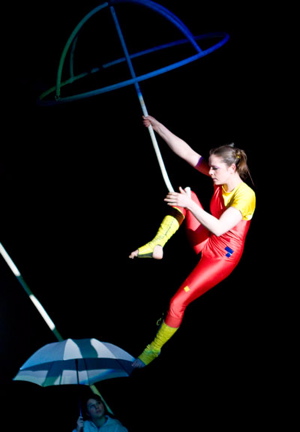
Less money, more intimate.
Less money, more intimate.
In 1984, the year Cirque du Soleil first toured Quebec, the Australian Flying Fruit Fly Circus came to the Vancouver International Children's Festival. The Fruit Flies performed circus arts at a professional level and toured the world -- and none of them were over 16. A young girl in the audience, Zoe Pratt, told her mother that they should start a circus school in Vancouver. So they did.
Like Cirque du Soleil, that school -- Cirkids, and its umbrella company CircusWest -- recently celebrated its 25th anniversary. While Cirque du Soleil has attracted 90 million spectators to wince at the whirling death wheels of Kooza, gawk at the slippery, nude forms in the fishbowl of Zumanity, and puzzle through the baroque clowns of Alegria, Cirkids' remarkable story goes largely unnoticed. Montreal is the uncontested global heart of contemporary circus, but in Vancouver, another circus community has been growing step-for-step with Cirque.
"We don't get a lot of interview requests," says Robyn McGuinness, the executive director of CircusWest. "Just around shows, for a little publicity blurb in the paper. No one in Vancouver has ever been interested in writing about circus for circus' sake."
Cirkids' current home is in the Garden Auditorium at the Pacific National Exhibition fairgrounds. Built in the 1930s, the building shows its age but has lost none of its grandeur. Once the site of big-band dances and huge concerts by the likes of Ray Charles and Stevie Wonder, Cirkids continues to make full use of the cavernous space.
Early in the morning, before anyone else has arrived, the mat-covered arena floor already suggests a childlike desire to run, leap, swing, and tumble. One corner has bars and wooden blocks for hand balancing. Single and triple trapezes hang from the distant ceiling, along with thick, silk ribbons used for the gravity-defying art of tissu. Kids of all ages will soon twist their bodies up in the fabric and then unravel the twenty feet to the ground.
McGuinness, a middle-aged woman with the efficient mien of a secretary, shows me around. She opens one of the cupboards and inside is everything a juggler could dream of: rings, scarves, balls, clubs and even curved knives and flame sticks. Nearby is a rack of gleaming unicycles, some of them five feet tall. After a stretch of floor that springs back against my feet, we pass through a collection of full-sized and mini trampolines. Missing ceiling tiles reveal even more athletic equipment. Yet something about each station is still like a playground or a toy, begging to be played with and explored.
Early days in 'circusland'
Cirkids began in more modest venues. Jay Nunns, the current artistic director, was one of the original 86 Cirkids, out of the hundreds who auditioned for the chance to be part of the first formal circus organization in western Canada. He describes their first space, the Osborne Gym at the University of British Columbia, with the wonderment of his 14-year-old self intact, as a once-a-week "circusland." He adds, "It was neat to see kids running away and joining the circus. Well, more like jumping in the minivan, getting driven to the circus, and being picked up promptly afterwards. You know."
Ian Pratt, Zoe's father and the first technical director of Cirkids, remembers those early days with less nostalgia. In an email, he writes, "We couldn't afford any commercial items, so we made everything. It was still a little scary at first to watch a teenage girl being whirled around five meters in the air, supported entirely by a swivel I'd made and a loop of webbing I'd sewed."
Nunns doesn't have the stripped-down, superhuman musculature typically associated with circus artists. "I'm not a small guy," Nunns says. "I'm bigger, beefier. I was always in positions of carrying, or lifting, or driving." He comes across as larger than life, with the broad gestures and endearing wit of a natural performer. Before Cirkids, Nunns' information and inspiration had come from an insurance salesman's office in south Vancouver.
"Jack Miller sold insurance, but he was really a magician," Nunns explains. When you passed through the beaded curtain at the back of his office, you'd see the large, glass display cases of a magic shop. "It wasn't like he was selling them out of the back of his truck. He had tricks and illusions, and juggling equipment, and all kinds of stuff." Nunns pauses. "For a geeky circus boy, it was nirvana. There was no circus community. This was my community."
Nunns, the geeky circus boy, continued "geeking along" -- juggling and riding a unicycle, organizing talent shows, and asking his parents for more gear. He remembers seeing the Flying Fruit Fly Circus that had awed Zoe Pratt. "They weren't pulling punches because they were kids. With kids, there's this charm factor. You think, 'Oh, they're so cute' and you forgive their mistakes. Well, they had ten or 12 people on a stacking bike."
Within a couple years of launching, Cirkids had added programs for younger kids, and had outgrown the UBC venue. They moved to the South Hill Gym and slowly began to take over the building -- but they were still required to clear out every night, so circus equipment began to fill one storage room and then another, then the change rooms, then the hallways. At the point when Cirkids became the sole tenant, holding classes and training upwards of thirty hours a week, the Vancouver School Board took possession of the building. Suddenly Cirkids found themselves asked to clear out for ESL exams. At the same time, they were turning away kids and turning down performances.
'I love shows'
Nunns' primary function as artistic director is writing and building the Cirkids shows. Growing up in Vancouver, I saw as many as I could. In their 2002 show, Out of Space, a group of young contortionists played aliens by strapping masks to the backs of their heads. Their already liquid spines appeared to bend in the wrong direction as they balanced on top of one another, the masks' dark, blank eyes staring out at the audience. The night sky had LED stars woven into costumes on a six-person trapeze. The man in the moon was a young woman, casting strange silhouettes from inside a loop that hung high above the ground.
When asked about their past performances, Nunns becomes increasingly animated. "I funded shows myself," he says, referring to his early years as a coach. "I would buy props and not claim the receipts. I love shows. I love putting together shows."
For the Lost City Circus, their 2004 show, Nunns insisted on the construction of a 50-foot boat. "People said, 'He's a bit nuts. He's building these boats.' People said, 'This is too big. Scale it back.'" Two rival ships appeared in this show: the good sailors had a tight wire built into theirs, and the pirate ship had a trampoline. Coaches and volunteers, hidden inside, pushed the ships forward on rolling castors. Sea creatures did slow handstands and flips on podiums, in wavering blue light, as though moving through water and not air.
"One year," Nunns says, "I really wanted to do a show about art. I wanted to bring art to life. I would look in the gym and people would have these huge smiles, both on their faces and on their bodies, like it was something they couldn't control. And I thought, I want to do a show about that. That moment of inspiration and joy in circus."
The set of that show, Circus Anonymous, was a gigantic version of a Piet Mondrian painting. Each of the iconic Mondrian squares was an apartment containing a scene. The lead character painted a symbolic painting, balancing on her hands with the paintbrush in her foot. "At the beginning of the show, everything was black and white, because it was a world without inspiration. As the characters discovered their place, their passion, their uniqueness, they got colour. At the end of it, it was rainbow colored. It was a real assault of the senses of colour. After the show, people would say, 'Jay, when did the colour come in? I didn't even see it.'
"And that was in a circus show. We didn't have any words; it was all physical and visual. And that's why I love circus. The audience was crying, and they were laughing, and they were cheering and the kids feel . . ." Jay falters here, unable to find the word. "They're not just doing this for the parents," he says, finally. "They're doing art."
A different bottom line
Cirque du Soleil's first show cost $1.5 million, most of which came from the Quebec government. It's hard to imagine that the artistic juggernaut which currently employs 4,000 people in 40 countries spent many years in debt and heavily reliant on government funding. According to executive director McGuinness, Cirkids and CircusWest have never received more than five per cent of their funds from the B.C. government, and then always for individual projects, never their basic operating costs. "Surviving in the non-profit sector for 25 years is no small feat," she says.
In 2003, when Cirkids moved into the Garden Auditorium, volunteer parents were still answering the phones and filling out registration forms. After a conscious decision to professionalize, staff was hired and plans were made for a paid, professional troupe. When asked what the goal was, Nunns says, "World domination."
Between their professional troupe and Cirkids, CircusWest has a large presence in the community. Nunns reels off a staggering list of festivals -- every festival I’ve ever heard of in and around Vancouver, and then some -- in addition to their own performances, public and private. Thousands of artists of all ages have passed through, and hundreds of thousands of spectators all over the province. Still, it is not Cirque du Soleil. To say CircusWest is overshadowed in Canada is an understatement.
The very name of Cirque du Soleil's own school, the National Circus School (NCS), implies its unparalleled status. The NCS has a dedicated high school and collegiate program, where students can train full-time, and an extracurricular program where children enrolled in regular schools train for a minimum of thirteen hours per week.
The Other Great Canadian Circus School: Page 1 of 2
What have we missed? What do you think? We want to know. Comment below. Keep in mind:
Do:
Do not: