


 SHARE:
It's a temptation when attending a film festival to gorge oneself. But like devouring an entire box of chocolates, you may occasionally end up eating a maraschino cherry or some other equally noxious thing. It's a better idea to do a little bit of research beforehand, to map out especially tasty confections, be they fudge caramel or nutty clusters, or documentaries about genocide.
The Victoria Film Festival (VFF) which launches next week, has a great many excellent films this year. So, much so, that I think it's worth braving ferry food to make the crossing to our capital city, where I intend to ingest as many films as I can stuff down.
When anyone asks me "What film should I go see?" My question to them is "What do you like?" This, of course, begs the question of taste. If you're not a horror film fan, skip the scary stuff. If you like romantic comedies starring Jennifer Aniston there is no hope for you at all. If you only go to mainstream stuff in the theatres, that's like trying to live exclusively on McDonald's food. There is an entire world of deliciousness at a big film festival. In the VFF, there is a veritable heaping helping of great films -- Collapse, The Wild Hunt, Yodok Stories, Pax Americana, The Yes Men Fix the World, and especially Terribly Happy.
Canada’s best film this year?
One of the things that I like most about the Victoria Film Festival, other than the opportunity to traipse around the city, is that it programs a lot of Canadian films. Lord knows I've had a few issues with Canadian film this year, but then something like The Wild Hunt comes along, and all is forgiven.
The story begins with a montage of Arthur Rackham's illustrations from Wagner’s Ring Cycle. Gorgeous pen and ink, watercolour images of Siegfried, Brünnehilde, Wotan and those really sexy Rhinemaidens. Back here in the plain old ordinary world things are somewhat less than epic.
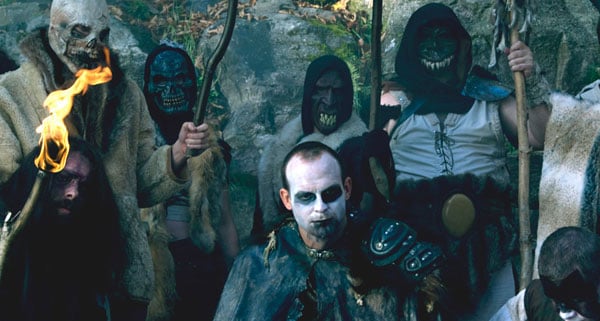
In a particularly bleak section of Montreal, a young man named Erik is struggling to care for his elderly demented father, and simultaneously attend to the needs of his girlfriend Evelyn. The strain is obvious. When Evelyn decamps to the woods, in the company of a shaman named Murtagh to partake of some live action role-playing, Erik is forced to enlist the help of his brother Bjorn. A strapping hysteric complete with a blond Viking wig and a hammer named Mjolnir (after Thor's famous instrument), Bjorn has seemingly abandoned any contact with the real world and is content to live entirely in the realm of Dungeons and Dragons.
In their verdant forest camp, far from the distractions of the modern world, Bjorn and his band of would-be Viking warriors are free to carry on something fierce, secure in the enveloping warmth of fantasy. It is a mythic place of magic, violence, desire, intrigue, plots and counterplots, even if the costumes are homemade and the weapons only foam copies.
When Evelyn is forced to participate in a ritual sacrifice that begins the eponymous Wild Hunt, things begin to spiral into something far more menacing. Real emotion soon escalates this game of make-believe into something terribly, horribly genuine. As the rules and careful structures that govern the action go up in a blaze of real violence, human nature in all its elemental ferocity is revealed. This unmasking is both terrifying and oddly thrilling.
A beautiful, blue debut
Alexandre Franchi's debut feature is beautifully made, rich with texture and colour, be it the deep blues of the forest at night, or the thin cold light of morning in a crappy apartment. It is also packed with enough moods and tonal qualities that you never quite know what to expect. The film was shot in an actual role-playing village, near Shawinigin, with real life-action role players playing themselves. There's a certain meta-level of reality implicit in this notion. It is this level of interactivity that reminded me of couple of recent documentaries.
Andrew Neel and Luke Meyer's Darkon and Keven McAlester's The Dungeon Masters also take as their subject the intersection between reality and the human yearning for bigger narratives. Like The Wild Hunt, Dungeon Masters captures the raw need for something bigger, a life rich with Wagnerian heft, studded with passion, fury, triumph and of course, great loss.
The fact that these big emotions take place in the dreariest and drabbest of setting makes it all the more poignant. Middle American with its strip malls, four-lane freeways and bland suburbs, an environment that James Kunstler describes in his book The Geography of Nowhere: The Rise and Decline of America's Man-Made Landscape, as "depressing, brutal, ugly, unhealthy and spiritually degrading," seems the antithesis of soaring epic passion. The fact that it (the passion I mean, not the suburbia) persists so tenaciously is curious indeed. It speaks to the deep-seated nature of this drive, something so fundamental that is cannot be driven out.
Tell me a big story
Pulitzer-prize winner Ernest Becker termed this need for larger narratives the "immortality project" and argued that the need to become part of something heroic is not only normal but necessary. Without this panacea, mortality is too terrible to contemplate. Even worse somehow is insignificance.
But larger stories also serve another purpose, in that they make for riveting tales. If no one is fighting, plotting, loving or killing, things can get terribly dull. Death, savage violence, awful tragedy make for great stories, unless you happen to be the character in that particular story, then you probably simply want to escape to a nice sitcom where nothing really bad ever happens. But tragedy is so rare in popular culture that its particular flavour tastes newly minted. Such is the case with The Wild Hunt.
The film has an interesting power that is partly derived from the hurtling momentum of its narrative. Even as the inevitable conclusion lurches into view, it is still shocking. When the Alexandre Franchi introduced his film at the recent Whistler Film Festival, he explained that his intention was to apply ancient concepts of honour, revenge, and passion to the modern world.
The results are profoundly disturbing and force you not only to reassess what big mythic things look like in the flesh, but also just how much the world has shrunk, so that it can no longer accommodate them.
Death and passion may be one thing on the operatic stage, a form of playacting, twice or three times removed from the genuine thing. Even film itself is only a form of sublimation, a type of rehearsal for life. But has life been so diminished, people kept purposefully small and fragile that they cannot cope very well anymore with pretend tragedy, much less the real thing?
Armoured against liars
Tragedy has served a critical function in plenty of different cultures, be it the Greeks or the Romans, continuing through to Shakespeare. It is a useful tool, one that playwright Howard Barker described as "You emerge from tragedy equipped against lies." The fact we see it so rarely is interesting then, especially in this current moment. Marginalized off to the side, it crops up in the damnedest places, such as live action role playing where people dress up like elves and wizards, and enact big stories of peril and courage.
Writes Becker, in the final sentence of his masterwork, the Denial of Death, "The most that any one of us can seem to do is to fashion something -- an object or ourselves -- and drop it into the confusion, make an offering of it, so to speak, to the life force."
In this The Wild Hunt succeeds most admirably. It lingers in your brain, like some Wagnerian thunder. Big, bold, bloody. And oddly enough, Canadian. ![[Tyee]](/design-article.thetyee.ca/ui/img/yellowblob.png)
Read more: Film




Tyee Commenting Guidelines
Comments that violate guidelines risk being deleted, and violations may result in a temporary or permanent user ban. Maintain the spirit of good conversation to stay in the discussion.
*Please note The Tyee is not a forum for spreading misinformation about COVID-19, denying its existence or minimizing its risk to public health.
Do:
Do not: