
- Ms Kaye is a Tyee Builder. You can be, too.
- Mary Carlisle is a Tyee Builder. You can be, too.
- Prem Gill is a Tyee Builder. You can be, too.
- Nancy Flight is a Tyee Builder. You can be, too.
- Justin Everett is a Tyee Builder. You can be, too.
- John Westover is a Tyee Builder. You can be, too.
- Nora Etches is a Tyee Builder. You can be, too.
- Edward Henderson is a Tyee Builder. You can be, too.
- Bharadwaj Chandramouli is a Tyee Builder. You can be, too.
- Dean Chatterson is a Tyee Builder. You can be, too.
- Marius Scurtescu is a Tyee Builder. You can be, too.
- Robert Parkes is a Tyee Builder. You can be, too.
- James Murton is a Tyee Builder. You can be, too.
- Susan Doyle is a Tyee Builder. You can be, too.
- Vincent Strgar is a Tyee Builder. You can be, too.
- Helen Spiegelman is a Tyee Builder. You can be, too.
- Subir Guin is a Tyee Builder. You can be, too.
- Kimball Finigan is a Tyee Builder. You can be, too.
- Joanne Manley is a Tyee Builder. You can be, too.
- David Leach is a Tyee Builder. You can be, too.
'Collapse'
Your chance to spend a bit of quality time with the world's foremost doomer.
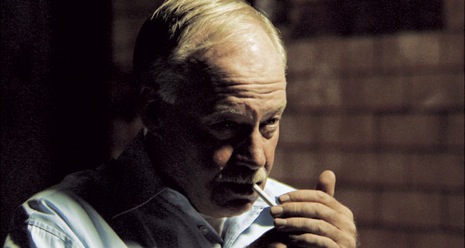
'Grow up or die': Michael Ruppert, subject of new documentary.
The thing that struck me most about Chris Smith's new documentary Collapse is not the end of the world scenario sketched out by its principal and only character Michael C. Ruppert. Rather, it is the sadness and loneliness that settles like damp cold inside your body while watching it.
The film dovetails strangely with other things going on in the zeitgeist at the moment, or perhaps, they're only going on in my personal zeitgeist. After I staggered away from the screen, I read Richard Rodriguez's article about the death of the American newspaper "Final Edition" in Harper's Magazine. That old saw you may say, but the ending of the essay pierced me like an arrow. As the author climbs his stairs, having collected his news from his front step, he writes "I am so lonely I must subscribe to three papers...The three together equal what I remember."
Rodriguez's article is about more than the loss of newsprint, institutions that were once upon a time pillowy and rich with classified ads, obits, and columns by men who wore pork-pie hats without irony, and let cigarettes stick to the side of their mouth dribbling smoke. Rodriguez is writing about death and the falling away of the things we remember and love about our world. Newspapers may just be black ink on white paper, but they represent a sense of community, of belonging, a sense of greater participation in the civic life, etiquette, social commerce, all that is human. A certain type of life that we remember. The fact that we are looking backwards at it means that things have already shifted.
Collapse deals with similar feelings, but through far darker scenarios. Even as Michael Ruppert, smoking intensively throughout, talks about the coming apocalypse and the price to paid by humanity, the first place that real hot live emotion comes spilling out is when he says, "We've have waited for so long, just for someone to listen to us." Is it any wonder that Ruppert's online newsletter is called From the Wilderness? His may be a lone voice crying to be heard, but he's not alone.
A clean sweep
When Ruppert says "us" he is ostensibly talking about the "doomers." They are a certain segment of the current cultural discourse who steadfastly maintain we're entering the last days. The end is nigh, and one must prepare for the coming transition to a new world paradigm. But first we must suffer through the decline of old institutions, newspapers, ideologies, populations, old dogs, old people. Death, that great efficient engine is self-cleaning, sweeping away all the old stuff to make way for the new. Before we can move on, though, the old stuff must be properly mourned, or at least understood.
That is what Collapse is engaged in doing. It is as much a backwards look at recent history, as well as a prediction for the coming change.
Predicting the future is, of course, a fool's game. No one really knows anything, but you can make an educated and thoughtful guess, which is exactly what Ruppert is apparently trying to do. People are beginning to pay attention, especially when even the mainstream media lets slip that things are not sunshine and roses.
Collapse has achieved what 30 years of writing and research had not for Ruppert, putting him centre stage, where he is interviewed by the Wall Street Journal.
Who is this guy?
Ruppert's own history is a deeply curious story. Born to parents who were both tied to the security community in the U.S., Ruppert joined the LAPD, only to discover that he too had a security clearance somewhere in the grey zone beyond top secret. As a young idealistic narcotics detective, he was recruited by the CIA to help smuggle drugs into the U.S. After attempting to blow the whistle on the CIA's drug operations, things got increasingly dicey for our hero. Ruppert's confrontation with CIA boss man John Deutsch is the stuff of Internet legend.
Betrayed a woman, shot at, and trying to survive, Ruppert's story sounds like the plot of many a bad movie. Whether it's true or wildly embellished probably matters little.
So, what does Mr. Ruppert actually have to say? He speaks of many things: peak oil, human population growth, nefarious doings by different governments around the world, mysterious deaths in the American army, the Tailwind Scandal about Sarin gas being used in Vietnam, FBI sabotage, strange burglaries, and above all financial twistiness. Ruppert maintains that his economic predictions were bang on the money, and quotes St. Timothy, who said that the love of money is the root of all evil. "It is the love of money that has the potential to exterminate, to render extinct the entire human race."
Signs of the apocalypse
"Politics is a continuation of economics by other means," he says and goes on to explain how derivatives, fiat currency and fractional reserve banking really work. The inherent madness of this system, if it hasn't already become extremely apparent from other sources, is made that much more explicit. Much of what Ruppert is talking about has been carefully taken apart in a number of other documentaries, most notably American Casino, Let's Make Money, Capitalism: A Love Story and We All Fall Down. Perhaps, the most eloquent elegy to society's collapse involves not talking head interviews at all, but pure image and sound combined to delirious effect.
Whether you believe what Ruppert has to say or you think he's a genuine loon, much of what is discussed in the film has either already happened or is in the process of happening. Peak oil will peak, no matter what humans do. For some of the larger forces set into motion, there isn't too much to do about them, other than perhaps crawl into a shallow hole in the ground and put your arms over your head. But it's important to look it in the face. Crawl out of your ditch, take your arms off your head and really look.
Director Chris Smith has borrowed from earlier documentary precedents, most obviously from Errol Morris, complete with a nervously muttering Philip Glass-type soundtrack that is used almost ironically. (In one scene, when Ruppert calls for a break, the music abruptly quits as well, and starts back up again, like a soundtrack for the damned, when he begins to speak.) The director interjects occasionally, playing the role of the skeptic on behalf of the audience, asking Ruppert a series of obvious questions. He gets slapped down a little bit, but it's a useful tool. Smith brings up the question of human ingenuity, which Ruppert counters with the laws of physics and the logic of closed systems, saying what we're witnessing is not just Social Darwinism, but real Darwinism.
But what really happens when a government collapses? Ruppert maintains that the real break will come when oil prices spike again and people can no longer afford to purchase the oil. When society breaks down, things won't disappear overnight, they will shudder, lurch and slide slowly into a stop. This may already be happening as different U.S. states deal with bankruptcy, and systematically cut services. Ordinary maintenance of things like roads, bridges and sewers, the infrastructure that supports modern industrialized society stutters to a halt. It's not just the U.S. where things will fall apart, other economies are also primed for collapse. The film name checks Britain, Eastern Europe, Mexico, Pakistan and Afghanistan. Says Ruppert: "The people who are running the planet are losing control."
'Grow up or Die'
Ruppert speaks well, in perfect little sound bites, and often comes across as arrogant, filled with hubris, but also vulnerable, sad, and scared. Calling for revolution in the human soul and mind, he growls "Every aspect of human existence is on the table." Political parties, religion, ideologies won't help anyone survive. They are archaic, dead fossils holding people back. The real quest is to find the right balance between growth and a planet with finite resources. "It's all about getting balance back. Grow up or die."
In the face of collapse, much of what is advocated is purely practical... store seeds, restore the soil, get rid of your cell phone, invest heavily in local food production. Ruppert cites two very different examples of what can happen when oil disappears, namely North Korea and Cuba. After the collapse of the Soviet Union, both nations were thrown upon their own resources, almost overnight. These very different scenarios provide an extremely useful primer in how survival can happen, or not, in the face of sudden and irrevocable change. Says Mr. Ruppert: "Community is what will save us... You will fail as a rugged individualist, you will survive as a member of a tribe or a family." Then he bursts into tears. Whether it's the notion of people coming together in the face of calamity or the fact that uncountable numbers of human beings will suffer and die as the world grinds to a halt is unclear. Personally I think it is the former.
Calling for a revolution in human thinking, what Ruppert also seems to desire is a return to human community. A stripping away of Wal-mart world and plastic vampire television culture. Real living encompasses fear and love and joy. "I see all that richness buried under such bullshit," he says. I have to admit at that point in the film, I thought "Right on, brother." But still... While there is a great deal of stuff I would not miss about contemporary culture, there is much that I would miss. Like Richard Rodriguez memorializing about the death of newspapers, there are many things that would be deeply mourned on a personal level.
From the biggest social crisis to the smallest heartbreak, it is impossible as a human to not be human. We are trapped by our own emotions, and our inability to surpass how we feel about things. But in the face of real honest to goodness genuine collapse, there may not be any time for waxing rhapsodic about the good old days and grand institutions that once were, no time for sentiment in the face of survival. Or as, Mr. Ruppert so eloquently puts it, "Climb down off the cross asshole, we need the lumber."
Collapse is playing at the Vancity Theatre on Nov. 17th and Nov. 21st. ![]()


33
Login or register to post comments
RickW
2 years ago
Reminds me of another "Collapse":
http://www.reviewsofbooks.com/collapse/
OilbertaRedTory
2 years ago
If, during the long course of ages
and under varying conditions of life ... there be a severe struggle for life ... but if variations useful do occur ... assuredly individuals thus characterized have the best chance of being preserved in the struggle for life ... and will tend to produce offspring similarly characterized. This principle of preservation I have called, for the sake of brevity, Natural Selection.
[Darwin was anything but brief]
Or not - Earth; post-human :
http://www.newscientist.com/article/mg19225731.100-imagine-earth-without-people.html?full=true
Intention Pure
2 years ago
Ruppert
Tied for first place for best book I ever read: Ruppert's Crossing the Rubicon, and Death in the Air by Len Horowitz.
Jeffrey J.
2 years ago
Very Timely
Timely and succinct coverage of a fascinating film.
The evidence of mass unravelling of society is quite remarkable. Related is the huge disconnect between what most 'real' people intuitively understand, and the hollow rhetoric from our elites. I suspect this disconnect is symptomatic of why things are so bad in the first place.
For a purely academic study, students of collapse should read Prof. Joseph Tainter's brilliant "Collapse of Complex Societies". His research is the most plausible account of how a complex society spends more and more effort trying to solve more complex problems, leading to a huge cost-benefit deficit where the complexity soon outstrips any possible utility for its citizens.
http://en.wikipedia.org/wiki/Joseph_Tainter
We are seeing examples of this at every turn. Opening a bank account is now a protracted undertaking of paperwork, ID verification and delays. 20 years ago, it was simple. Buying a house has become a complex, expensive process, whereas 20 years ago, it was easier. Accessing a government service now is overwhelming. Before, you could make a phone call and someone would answer and try and help. A middle class family now has to spend $1,000 per year for: house insurance; car insurance; dental insurance; tax preparation; legal fees; all as their incomes drop. The list goes on and on.
These are perfect examples of a system that is so complex, so obtuse, so completely disconnected with people's needs, they are walking away from the entire edifice, which is so top heavy it is about to topple over onto its citizens below, crushing us.
Tainter's parallel thesis is that people will simply avoid using the highly complex system and revert to a simpler method, any method, that requires less effort. Enter the cash society, where more and more people are dropping out of the upper middle class world of credit checks, investment funds and expensive lawyers and accountants and bankers and insurance agents. Instead, people are turning to cash, pot, drugs, gangs and the entire underground economy that is exploding.
While 'simpler' in so many ways, it is also a jungle, devoid of justice, equality and social fairness.
This vision is brilliantly explored by Howard James Kunstler's World Made by Hand, (he also wrote The Long Emergency), a frightening expose of a world without law.
http://www.amazon.ca/World-Made-James-Howard-Kunstler/dp/0871139782
Great coverage by one of my favorite Tyee writers!
max von smartt
2 years ago
peak oil apocalypse
Sounds interesting but Ruppert must be overrated as world's foremost doomster. Peak Oil is not suddenly going to turn off the taps and there are many alternative energy sources and vast room for improving effeciency and reducing consumption. It is a finite planet and there will be corrections to the burgeoning population explosion.
I will wait to see this on DVD.
RickW
2 years ago
Jeffrey J.
It's the lawyers, Jeffrey. They have been a curse and the nemesis of every civilization. Because no one knows exactly what a lawyer might seize upon oppotunistically (either on his/her own behalf or her/his clients' behalf), the paperwork is becoming infinitely more complex.
When the revolution begins, harken to the words of The Bard himself: "The first thing we do, let's kill all the lawyers".
KWD
2 years ago
time to think about thinking
I guess I’m part of the “doomer” cabal.
Anyone who has taken a questioning, rear-view look at the world around them knows we are well into the “Collapse”. “The fact that we are looking backwards at it means that things have already shifted.” That we are witnessing the “death and the falling away of the things we remember and love about our world” is too obvious.
Michael Ruppert hits the nail on the head when he calls for “ revolution in the human soul and mind”. The message here is, undeniably, a call for a revolution in human thinking. When, and if, it happens every aspect of human involvement in the noosphere will come under scrutiny.
Unlike Rupert, I don’t think the real quest is finging the right balance between growth and resources, rather it’s finding a human population dynamic that fits those resources. (Probably nitpicking but I see a distinct difference.)
Peak oil is a blessing. And when you really think about it, if there is a revolution in human thinking, it will expose more than capitalism’s carbonated Achilles heel. Today, those in the soft green environmental movement … the Suzukis and Bermans … have also become the earth’s enemy. These are the folks, co-opted by the joys of celebrity, that respond to corporate greed with oxymoronic regularity, “We’re not against growth, but let’s do it with concern for the environment”.
Jerry Munro
2 years ago
About doing as one is told...
There is no doubt that we are living through a time of increasing pessimism about human prospects. And no doubt, as Jeffrey J. points out, even over just my lifetime, which probably saw the greatest urbanization drive in history, and all the "complexities" that has gone on with that... Which technology was going to make paperless and easier, and never did nor will. ...the workings of what passes for the "free market" has created strangling complexities and insecurities in peoples' lives. Which has been in climaxing crescendo since the late 70s to early 80s, when the current great Neocon crisis of "the order" began to become inescapable, sowing so much pessimism leading to all this "collapse" concern of the present, at least as I have observed it.
By contrast, the earlier period from the time shortly after the end of the last "great war" until then, lasting certainly into the 60s, was a time of "seeming" material improvement in the mass of peoples' lives and growing optimism that, for example, Marx had been wrong in his predictions about capitalism, and that the potential of the system was conversely "infinite". (Socialist, Communist and Anarchist parties and grouping were falling by the wayside, an increasingly isolated minority.)
.
Jerry Munro
2 years ago
About doing as one is told 2...
From previous post...
This optimism no longer exists, of course, certainly for the masses, since the rise of the lean and mean Neocon Order. But as well by then, even for the masses, it was already becoming obvious, outside of the theories and predictions of environmentalists, that the wasting of the natural order by the excesses of the "free market" and population growth was producing irrevocable loss and damage in biodiversity and changing weather. (For those of my generation, it was not necessary even to develop the whole modern environmentalist radical "green" movement analysis, though it has perhaps helped those of you who have arrived more recently. With half a brain even, we were witness to it, had lived it, most of us as its "wage slaves" and could see it, and knew that the flora and fauna were in increasing crises. From loggers to farmers to fishermen, we were increasingly aware, if not perfectly, or should have been, that even the weather was changing.
It was not a sudden, but a creeping realization of course, as all such things are.
Aye, kill all the lawyers. But kill the orchestrater's of organized "free market" chaos and greed, and endless growth as well. For they had all the REAL power and strategic interests that drove it. The rest of us are in part to blame as well, no doubt, but largely we were dragged and herded along, driven from the land to become the proletariat to the process, doing as we were told, like all good Germans, as it was chauvanistically said by the wartime generation. (Not seeing, of course, that they themselves did the same.)
Our conditioning was to stand at the Seig Heil and click our heels at every mailbox, in deference to The State, our ruling class betters, and Law and Order. And we, or most, did precisely that.
This film sounds interesting though. I will make a point of seeing it, if I hear of a nearby town with a theatre that will show it. Right now the preference is for escapist fantasy and cartoon pap.
The more things change, the more they remain the same... at least within the prevailing order of things
KWD
2 years ago
will it be the meek?
“ … assuredly individuals thus characterized have the best chance of being preserved in the struggle for life …”
Yes, how true. No where is this more evident than in wild salmon. Those that frequent salmon bearing rivers, and have watched the spawning ritual, are impressed by the persistence of a large buck, trying to preserve his character by chasing competitive males away from his doe.
But if enough time is spent observing the battle one soon discovers that size and physical strength are not part of Darwin’s equation. More often than not , as the big, powerful male lunges at equally large intruders, a much smaller precosious “jack” slides out of the shadows and makes a contribution to the gene pool.
Jeffrey J.
2 years ago
Lawyers, accountants, brokers, politicians
It's important to understand that lawyers, accountants, brokers and politicians all 'appear' to have power. But in the end, do not. They are handmaidens. For the oligarchs. It's somewhat complicated, but not that much. There are many, many academic critiques of who really calls the shots. And they are in some ways, plainly obvious, and in other ways, invisible. The usual: the oil cartel, banks, insurance industry, media owners, real estate developers, media, military (in no particular order).
Each group has their own coterie of vassals and handmaidens: lawyers (actually, 'solicitors', NOT barristers); accountants, brokers, politicians, consultants.
But the real power resides in those who call the shots.
There are actual examples of members of each of the 'professions' (lawyers, accountants, etc) trying to fight back against the regime. Seriously. But they by and large fail. There are even realtors who have critiqued the real estate monopoly system. Very impressive! But they too are squashed by their monopoly. No coverage of these efforts at reform or revolution ever ends up in the media.
History has proven, time and again, that it is only organized citizen direct action that results in actual change.
Great discussion!
Jerry Munro
2 years ago
Scurrying about the undergrowth
"...a much smaller precosious “jack” slides out of the shadows and makes a contribution to the gene pool." Wrote KWD.
As much smaller, precocious jacks ourselves, thee and me should surely know the truth of this observation. :-) It is what the Neocons miss, in their focus on only wealth and power.
And it was not the large that survived the Age of Dinosaurs, but the small ferret like animals and smaller that scurried about the underqrowth, in their shadow. When the dinosaur's time ended, they emerged to taker over the planet.
Our mistake has been, that we then came over the millenia since have come to think that we should ourselves then become the titans of the New Age. It is out of this has arisen the new feared Time of Collapse. And for good goddamn reason.
It is not the unambitious, or those of more modest ambitions and contentments so much that are the problem, but the greedy type A personality bastards that inevitably, sooner or later, bring it all to wrack and ruin, as they have in the current time.
It is not the tigers of the Age of Humans that are of greater likelihood to survive The Collapse, but the rats and weasels in the undergrowth, and the "jacks" that slide in, slip it in, and do the job while the anally ambitious get their rocks off getting rich. :-)
RickW
2 years ago
Jeffrey J.
It has been noted that one of the first things to be attacked and destroyed during the French Revolution were the tax records and land deeds..........
RickW
2 years ago
coyoteman and environmental destruction
http://www.independent.co.uk/news/science/why-the-nascas-big-mistake-was-to-cut-down-the-huarango-tree-1813180.html?
It's been going on a long time, methinks.........
lynn
2 years ago
Complex stuff
Jeffrey J. wrote:
Quote:
"We are seeing examples of this at every turn. Opening a bank account is now a protracted undertaking of paperwork, ID verification and delays. 20 years ago, it was simple. Buying a house has become a complex, expensive process, whereas 20 years ago, it was easier. Accessing a government service now is overwhelming."
A great deal of that frustrating complexity is due, I think, to the increasing levels of subterfuge built into the system.
The lies and the fraud have to be hidden....or disguised.
The less direct, the more circuitous and dizzying the route, the better.
An elegant simplicity in both systems and in people....most of all in nature itself, has been intentionally down-graded as "just not enough" and somehow inefficient.
Enjoyed reading this discussion.
Always enjoy reading your reviews as well, Dorothy.
This one, especially.
Jerry Munro
2 years ago
The complexity of systems based on lies...
Lynn writes, "A great deal of that frustrating complexity is due, I think, to the increasing levels of subterfuge built into the system.
The lies and the fraud have to be hidden....or disguised.
The less direct, the more circuitous and dizzying the route, the better."
I agree entirely, Lynn. A great observation.
A lie invariably has to become more and more complex, especially as the questions raised get more deeply probing, and is almost always the fatal weakness that exposes it finally. And the lie at the heart of "the system" is, that the source of wealth and profit is the genius of the capitalist and not the labour of the mass of wage slaves, and it is this claimed "genius" that justifies his/her special power. When, in fact, it is really just theft of share taken from the lower orders of society and their "collective/social" economy, over many, many "free market" transactions, including the prices for goods and the payment of wages. All of which has to be hidden beneath layers and layers of transaction subterfuge. And all the other tagged on, accumulative additional lies, that attempt to explain away such as persistent poverty and environmental destruction for example, add to the seeming insurmountable complexity, seeking to deflect the blame to the victims of the "free market" theft.
"Oh, what a complex web we weave, when first we practise to deceive," is the simple truth of the old saying. Which includes socio-economic systems based on deception at its foundation.
In good times, people are prepared to, and do, ignore the lie, which they cannot in the bad, when it all comes unglued, as now, in our time.
KWD
2 years ago
getting to the next layer
Although subterfuge is by no means a new phenomena, it seems, as lynn points out, to be increasing and “dizzying the route”.
While subterfuge might be a component of the process by which complexity increases, it is not the cause, it’s a symptom. If we dig down, and "get more deeply probing", as Coyoteman suggestes, we are faced with asking, “Why are we hiding or trying to escape responsibility for our actions?” and, “What’s behind the increase?”
Finding the answer to the first question is not too difficult. It’s part of our basic survival response … avoid the pain (of punishment) and seek pleasure. And to avoid pain we are forced to do what ever necessary to cover our arse. Hence, the dependance upon, and proliferation of, overwhelming amounts of processing ... office memos and emails, and the increasing reliance on lawyers to avoid liabilty.
Finding the answer to the second may not be so easy. One can only suspect that the rate of increase of subterfuge is directly related to the rate of increase in the speed of communication.
But all technology is a double edged sword. Although the rapid increase in subterfuge may parallel changes in communication technology, one would hope subterfuge is also in the process of collapse.
Examples of this might be found in the proliferation of charges directed at folks in the financial sector. The Ponzi artists are on the run, and if questions and awarness are allowed to reach a critical mass, the world’s Wall Streets will be exposed as any but “free”.
“The fact that we are looking backwards at it means that things have already shifted.”
Though we may be witnessing the “death and the falling away” of the capitalist lie, one has to wonder if many will see it as a love lost.
rangergord
2 years ago
Collapse
I have been reading Ruperts writings since 2001. Not sure I subscribe completely to the peak oil scenario but the overall theme is valid. I am not a gloom and doomer but a collapsarian. I am convinced that the system must crumble, decay, and die for a renewal on a sound basis to be possible. To that end I have taken Rupert's advice, buy gold and invest in local food production.
Jerry Munro
2 years ago
Everybody thank the Neocon for his/her help...
"To that end I have taken Rupert's advice, buy gold and invest in local food production."
lol. The system creates them like flies, or leeches. Nay, it is why they are called vultures or "bottom feeders". Then they come in here just to piss us off with their rank Neocon, flesh eating opportunism. :-)
KWD writes, "Finding the answer to the first question is not too difficult. It’s part of our basic survival response … avoid the pain (of punishment) and seek pleasure. And to avoid pain we are forced to do what ever necessary to cover our arse"
And you are right, of course, KWD. It is also the explanation at root of my concluding observation above, that "In good times, people are prepared to, and do, ignore the lie, which they cannot in the bad, when it all comes unglued, as now, in our time."
They, being the masses, ignore the lie(s) at the heart of the system in the good times, because they are in the "pleasure zone" that comes after a period of having been beaten over the head. There is a good chance even, to which I will attest, that it will immediately bring isolation and pain. To oppose the system in such a time would threaten your personal "pleasure".
They cannot ignore the lie(s) in the bad times of course, because they are in pain anyway, and in the quest to rediscover "the pleasure source", there is little to no hope of recovering it without facing up to and dealing with the lie(s) between themselves and "it".
Elementary Pavlov, dear boy. :-)
And thanks to our Neocon investor as well, who helps make that elementary truth clear here. Keep it up, you dim bulbs of capitalism. :-) lol. We could not organize the revolutionary alternative without such as your cynical participation here above.
Cynic
2 years ago
The good news is that there
The good news is that there is hope in money reform. Our challenge is to wrest control of the money supply out of the hands of the elite, stop money from being loaned into existence at interest so that a permanent means of exchange can circulate for the benefit of all. This will put an end to the "growth" imperative, an end to poverty and homelessness, and put a beginning to the glory of human potential.
The world as it is is not our fault, this system is being imposed upon us by the fascist elite. They must be brought down or our future may well be doomed. Time will tell.
KWD
2 years ago
money reform
You'll need an army if you're thinking about taking control of the money supply.
http://www.informationclearinghouse.info/article23812.htm
Cynic
2 years ago
An army called the people.
ME2
2 years ago
Reform, cynic?
Thank you for your posting this story above, RickW
Quote:
"Why the Nasca's big mistake was to cut down the huarango tree"
That story, with its endless variations which always result in final failure, should surprise no one these days.
Except, of course, the Marketeers, who hold it to be true that all ills, environmental or societal, will be overcome by "Market Forces". That belief is reinforced by their shared belief - as per Coyoteman's quote :
"To that end I have taken Rupert's advice, buy gold and invest in local food production."
In other words..."I don't care what happens - I
got my ass covered"
They're "gonna run 'er til she breaks, boys", and the devil will take the hindmost.
You're hoping they'll mend their ways and reform the system before then?? ROFLOL
rangergord
2 years ago
Neocon? coyote
To call me a neocon investor is proof enough that you have no idea what you are talking about. I work to provide my local community with food that the so called free market has failed to provide. I work to improve my community but I have no assurance that the system that supports it will survive. So I buy the only insurance avaliable with the little spare cash I have. Not exactly like sitting in a ivory tower designing a financial crisis so I can come in afterwards and buy up what is left like the real neocons. I do care but the reality is the system is corrupt and so resistant to change that it must die in order for true reform to be possible. As I am sure cynic knows monetary reform without gold is impossible.
rangergord
2 years ago
Neocon? coyote
To call me a neocon investor is proof enough that you have no idea what you are talking about. I work to provide my local community with food that the so called free market has failed to provide. I work to improve my community but I have no assurance that the system that supports it will survive. So I buy the only insurance avaliable with the little spare cash I have. Not exactly like sitting in a ivory tower designing a financial crisis so I can come in afterwards and buy up what is left like the real neocons. I do care but the reality is the system is corrupt and so resistant to change that it must die in order for true reform to be possible. As I am sure cynic knows monetary reform without gold is impossible.
nightbloom
2 years ago
Doomer = Boomer
The Baby Boomers are in an apocalyptic mood now that they're catching the whiff of their own mortality. As usual, they're projecting their internal Sturm und Drang onto society and are having visions of the Four Horsemen everywhere they look. Some of the issues are legit, but some are hold-overs of 60s radicalism gone sour. The population "crisis" (a notion first popularized by Harry Harrison's 1966 hit "Make Room! Make Room!") is already resolving itself, and a lot of young innovators and economists have a more circumspect outlook on "peak oil" theory, and some even see it as the beginning of a new and promising era replete with opportunities to finally "get it right" and make the world genuinely better. The Boomers will never see that era, and can't even imagine it, but that's no reason for the rest of us not to.
Besides, projections of apocalyptic collapse has already been done, and in a far grander style. He may have been wrong, but Oswald Spengler at least dazzled us when he took us all for a ride.
And politics isn't actually the continuation of economics by other means; that's a glib throw-away rip-off cliché that suggests an extremely myopic and short-term outlook on history.
ME2
2 years ago
Show biz
Don't give up on politics yet, folks
[www.guardian.co.uk]
LOL
Jerry Munro
2 years ago
Bloomer's boomers...
Well, being pre-baby boomer, I at least can be sure that the nightbloomer isn't talking about me. :-) And there ain't nobody more "apocolyptic" than Roman Catholicism, to which the nightbloom still clings, if in denial, for reasons of his own. :-)
But, even if you were right bloomer, probably a "boomer" himself, which you ain't been yet, at root it's gotta be that goddamn fire and brimstone Christian heritage bullshit we all went through, eh?
Except, it ain't really so much about the apocolyptic end of the world yet, just capitalism. Though, if it ain't the end of capitalism and its morality, or lack thereof, and imperatives, then at the rate its Greed System is fucking things up, we really could be in danger of the End Time of, at least, the human species... or a great chunk of it. (Though other life forms are likely to go on, even in the worst case scenario for humans.)
It depends on how humans respond to the times.
Catch the difference between this vision and the real apocolyptic vision of true believer Christianity?
It ain't cast in Biblical stone, bloomer. All it says is, get off your ass and stop worshipping those false Gods of Christianity et al, who have messed up your head and courage to ACT.
Jerry Munro
2 years ago
I'm stilling rolling,,,
I'm still rolling on the ground with laughter, at the temerity of an adherent/apologist for Christianity, Catholicism at that, calling anyone else "apocalyptic".
The end time must be truly at hand. :-) At least the time of the 3rd anti-Christ. :-)
Sookemark
2 years ago
The CIA and Afghan Opium
In his movie on 9/11, he predicted that the year following the US attack on the Taliban, the opium trade would return. Of course, it did. Recently Kharzai's brother has been identified as hip deep in the trade and on the CIA payroll. I can only trust that the CIA now has restored their unreported cashflows to finance their unreported activities. And, yes, it will be the kids in Vancouver and Montreal, as well as LA and NYC, who will steal our goods in order to provide that money. Not that anyone really cares.
freebear
2 years ago
Looking forward to it!
The only way it seems real change will happen!
realisticman
2 years ago
Come Together
I was getting worried there for a bit. At first I thought that we might as well give away all our livestock; or maybe eat them. Maybe just go for a long walk off a short pier. So I read it again and was quite reassured. Excited, actually.
.."Says Mr. Ruppert: ..Then he bursts into tears. Whether it's the notion of people coming together in the face of calamity or the fact that uncountable numbers of human beings will suffer and die as the world grinds to a halt is unclear. Personally I think it is the former."
Whew! That was close, thank god it's not the latter.
In my humble opinion and based on purely personal experience over and over again, there's nothing in this life quite as good as people coming together.
Peter Evanchuck
2 years ago
end of times, life and other things
Wow ! and Wow again, amazing analysis a man with guts and balls. Rare.